

T-Money Card Korea: Price, Fares, and How to Refund It (Updated August 2026)
₩2,500–4,000 for the card, ₩1,550 per subway ride: what T-money costs, where to buy it at CU, GS25, or Incheon, and how to refund leftover balance.
A T-money card costs ₩2,500–4,000 (~$1.80–2.90) at any CU, GS25, or 7-Eleven, plus whatever balance you load, and it works on subways and buses nationwide including Seoul, Busan, Daegu, Daejeon, and Jeju. As of 28 June 2025, the adult base subway fare with a T-money card is ₩1,550 (~$1.10), about ₩100 (~$1) cheaper than paying cash.
| Item | Amount (KRW) | Approx. USD | Where / notes |
|---|---|---|---|
| Standard card purchase | 2,500–4,000 | $1.80–2.90 | CU, GS25, 7-Eleven; price varies by design, not refundable |
| Korea Tour Card (tourist version) | 4,000 | $2.90 | Incheon T1/T2, Gimpo Airport, Myeongdong Tourist Info Center |
| Adult subway/bus fare (card) | 1,550 | $1.10 | Seoul, Incheon, Gyeonggi, effective 28 June 2025 |
| Adult subway/bus fare (cash) | 1,650 | $1.20 | Cash costs ₩100 (~$1) more than card on every ride |
| Youth fare (13–18, card) | 900 | $0.65 | Requires date-of-birth registration within 10 days of first use |
| Child fare (6–12, card/cash) | 550 | $0.40 | Same fee for card and cash since 28 June 2025 |
| Maximum balance loadable | 500,000 | $360 | Top up in ₩1,000 (~$1) units at machines or convenience stores |
| Refund at convenience store | up to 20,000 | up to $14 | GS25, CU, 7-Eleven, Ministop; ₩500 (~$1) fee deducted; whole-balance only |
| Refund at subway service center | 20,000–50,000 | $14–36 | Refunded in ₩10,000 (~$7) units; ₩500 (~$1) fee applies |
| Refund over 50,000 | 50,000+ | $36+ | T-money Town, Seoul City Tower 1F, near Seoul Station Exit 10 |
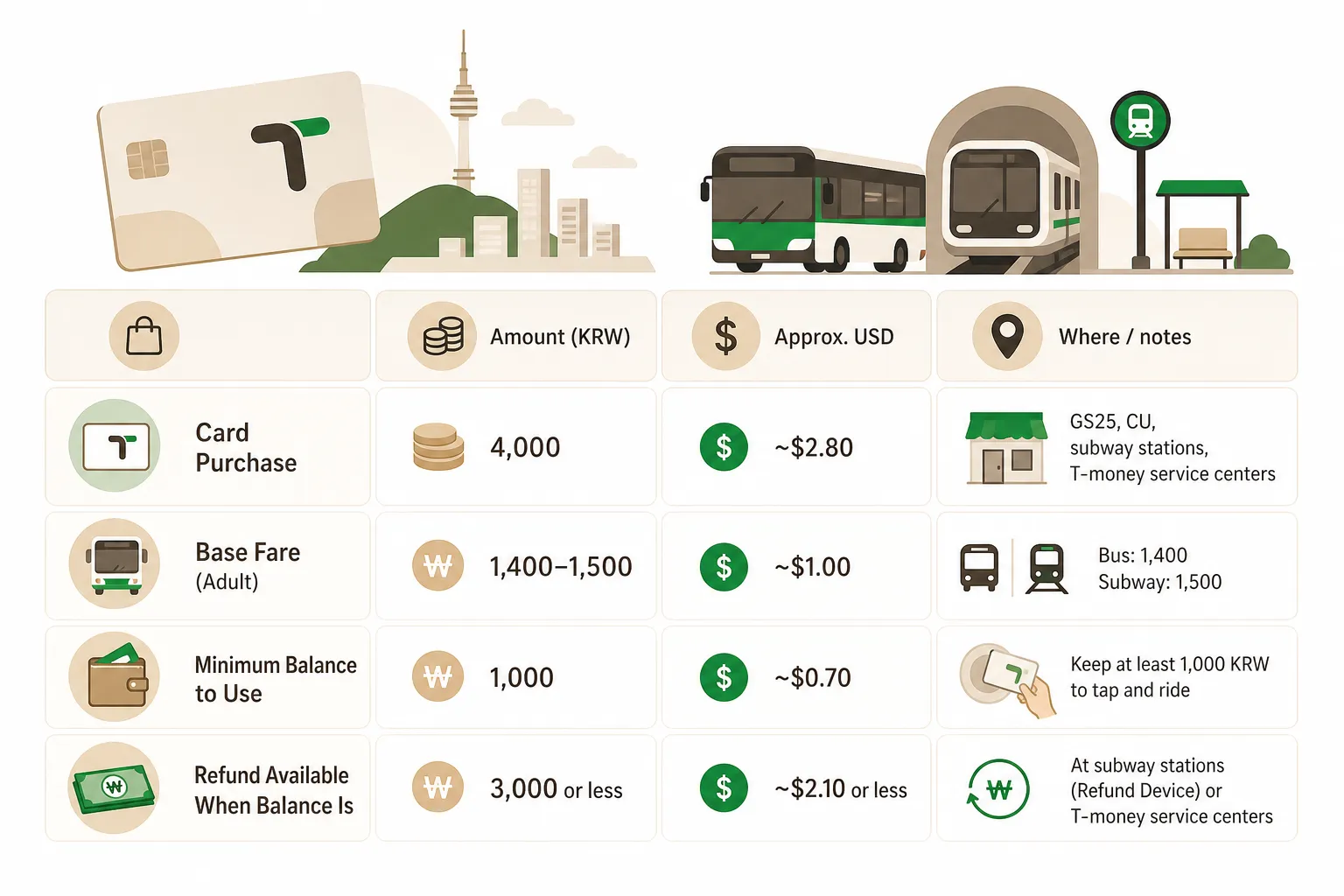
What is a T-money card and do you need one?
A T-money card is Korea's rechargeable smart card for public transport, used to tap in and out of subways, buses, and most card-reader taxis in Seoul Metropolitan Area, Busan, Daegu and Daejeon, with bus coverage extending to Jeju and many other provinces. You don't strictly need one — cash and single-journey tickets exist — but paying cash costs ₩100 (~$1) more per ride, and cash requires exact change or a ticket-machine transaction each time. For a visitor spending several days riding transit, the card pays for itself within a handful of trips and works interchangeably across the subway system covered in the Seoul subway guide. One card per traveler is standard practice, since fares are charged per tap, not per group.
How much does the card cost and where do you buy it?
The standard T-money card costs ₩2,500 to ₩4,000 (~$3) depending on the design, sold at CU, GS25, and 7-Eleven convenience stores across the country, including inside the arrivals halls at Incheon Terminal 1 and Terminal 2. This price is for the card itself and excludes any transit credit — you load balance separately at the counter or at a top-up machine, in ₩1,000 (~$1) increments up to a maximum of ₩500,000 (~$357). A tourist-oriented alternative, the Korea Tour Card, costs ₩4,000 (~$3) and is sold at Incheon T1/T2, Gimpo Airport, and the Myeongdong Tourist Information Center, sometimes bundled with 24/48/72-hour unlimited options.
Current fares: how much does each ride cost
From 28 June 2025, the base adult subway and bus fare with a T-money card is ₩1,550, (~$1) up ₩150 (~$1) from the previous ₩1,400 (~$1) rate, applying across Seoul, Incheon and Gyeonggi Province. This was the second stage of a planned increase, following an earlier rise from ₩1,250 to ₩1,400 (~$1) in October 2023. Cash fares run ₩100 (~$1) higher at ₩1,650 (~$1) for adults. Youth (ages 13–18) pay ₩900 (~$1) with a card, and children (ages 6–12) pay ₩550 (~$1) regardless of card or cash. If you switch between bus and subway within roughly 30 minutes of tapping out, the system treats it as a transfer and doesn't charge a second base fare, so long trips across multiple lines and bus routes often cost just one fare plus small distance surcharges.
Getting a refund before you leave Korea
Refunds depend on how much balance is left on the card, and the card price itself is never refunded — only the remaining transit credit. For balances up to ₩20,000, (~$14) most convenience stores (GS25, CU, 7-Eleven, sometimes Ministop) will refund the entire balance in cash, minus a ₩500 (~$1) service fee — so a ₩10,000 (~$7) balance returns ₩9,500 (~$7). Stores generally cannot do partial refunds; it's all or nothing. For ₩20,000 to ₩50,000, (~$36) head to a subway station's Customer Safety Center or Information Center, where refunds are issued in ₩10,000 (~$7) units, again minus the ₩500 (~$1) fee. For anything above ₩50,000, (~$36) the only option is T-money Town at Seoul City Tower, 1st floor, near Seoul Station Exit 10.
Fare rules, refund thresholds, and where the refund counters physically sit are the parts visitors get wrong — arriving at Incheon security with a loaded card and no refund counter past that point, or expecting a partial cash-back at a convenience store when only full-balance refunds are allowed.
Ask a KOncierge local guide to fold transit logistics into your full Korea itinerary.
Ask KOnciergeBy passport
- United States / Canada / Australia / UK
- No special registration needed for a standard adult T-money card; buy and tap immediately with any passport.
- All markets, transiting via Incheon
- Convenience stores selling T-money cards are past the arrivals gate at Incheon T1 and T2, so buy on arrival rather than trying to source one before departure.
Frequently asked questions
How much is a T-money card in Korea?
The card itself costs ₩2,500 to ₩4,000 (~$1.80–2.90) depending on the design, sold at CU, GS25, and 7-Eleven convenience stores nationwide. This is separate from the transit balance you load onto it, which you can top up in ₩1,000 (~$1) increments up to ₩500,000 (~$357). A tourist-branded version, the Korea Tour Card, runs a flat ₩4,000 (~$3) and is available at Incheon and Gimpo airports and the Myeongdong Tourist Information Center.
Can I get a refund on my T-money card balance?
Yes, but only the leftover balance, never the card price. Convenience stores refund the full remaining balance in cash if it's ₩20,000 (~$14) or under, minus a ₩500 (~$1) service fee. For ₩20,000 to ₩50,000, (~$36) go to a subway station's Customer Safety Center, where refunds come in ₩10,000 (~$7) units. Anything over ₩50,000 (~$36) requires a visit to T-money Town near Seoul Station's Exit 10.
Do I need to buy a T-money card, or can I just pay cash?
You don't need one, but it saves money and hassle. As of 28 June 2025, cash fares run ₩100 (~$1) higher than card fares on every ride — ₩1,650 (~$1) versus ₩1,550 (~$1) for adults — and cash requires exact fare or a ticket machine transaction each time rather than a single tap. Most visitors staying more than a day or two find the card worthwhile.
Does the T-money card expire or need a deposit?
No to both. The card has no expiration date, so you can keep it for years between trips to Korea, and there's no separate deposit — the purchase price you pay upfront is simply the cost of the physical card. Only the loaded transit balance can later be refunded, not the card price itself.
Does T-money work outside Seoul, like in Busan or Jeju?
Yes, T-money works on rapid transit in Seoul, Busan, Daegu, and Daejeon, and on buses in many provinces including Jeju, plus in most card-reader taxis nationwide. It's a single card for the whole country's public transit, not a Seoul-only pass, which is one reason it's worth buying even on a trip that includes a Busan itinerary.
Can Apple Pay or Google Pay replace a T-money card?
Not reliably for international visitors. Apple Pay and Google Pay transit functions on Korean systems are generally tied to Korean-issued accounts, and international Samsung accounts are similarly blocked from Korean NFC transit enrollment, so a physical T-money card remains the simplest option for foreign travelers rather than relying on a phone wallet.
Sources
- Subway base fares in Seoul, nearby areas rise by 150 won - The Korea Herald — koreaherald.com
- Seoul subway fares to increase to 1,550 won starting June 28 - The Korea Herald — koreaherald.com
- Seoul-area subway fares to increase by W150 on June 28 - The Korea Times — koreatimes.co.kr
- Seoul Subway Fare Hike 2025: What Travellers Need to Know - TripZilla — tripzilla.com
- 구입방법 - 이용안내 - 티머니 (T-money official purchase guide) — t-money.co.kr
- 카드 결제 | 결제 서비스 | 티머니 기술 | 티머니 (T-money official) — tmoney.co.kr
How was this article?


