

Korea T-money Card: Price, Where to Buy, and How to Use It (Updated July 2026)
How much a Korea T-money card costs, where to buy it, current subway and bus fares, transfer rules, and how to get a refund on leftover balance.
The T-money card is a rechargeable transit card that works on subways and buses across nearly every Korean city, plus many taxis and convenience store payments. Buy one for ₩2,500–₩4,000 (~$2–3) at any GS25, CU, 7-Eleven, Ministop, or emart24, no ID or registration required, then top up cash at the same stores or station vending machines.
| Item | Price (KRW) | Approx. USD | Notes |
|---|---|---|---|
| Basic T-money card | ₩2,500–₩4,000 (~$3) | ~$2–3 | Bought at convenience stores, no ID needed |
| Recommended top-up amount | ₩20,000–₩30,000 (~$21) | ~$14–21 | Suggested per load to avoid frequent recharging |
| Seoul subway base fare (T-money) | ₩1,550 (~$1) | ~$1.10 | Covers first ~10 km, +₩100 (~$1) per extra 5 km |
| Seoul subway base fare (single ticket) | ₩1,650 (~$1) | ~$1.20 | ₩100 (~$1) more than T-money fare |
| City bus base fare (blue/green) | ₩1,500 (~$1) | ~$1.10 | Rose ₩300 (~$1) in August 2024 |
| AREX express, Incheon Airport → Seoul Station | ₩4,150 (~$3) | ~$3.00 | Non-stop express train |
| Sample fare: Hongdae → Gangnam (~12 km) | ≈ ₩1,650 (~$1) | ~$1.20 | Distance-based add-on applied |
| Sample fare: Seoul Station → Suwon (~34 km) | ≈ ₩2,050 (~$1) | ~$1.50 | Longer intercity subway trip |
| Climate Card, 30-day unlimited (with bike) | ₩65,000 (~$46) | ~$46 | Confirmed April 2025 |
| Climate Card, 30-day unlimited (no bike) | ₩62,000 (~$44) | ~$44 | Seoul-area unlimited pass |
| Refund threshold for leftover balance | Under ₩20,000 (~$14) | Under ~$14 | Refundable at convenience stores, minus small fee |
| Card price + one top-up: roughly ₩22,500–₩34,000 (~$16–24) to start riding, USD approximate | N/A | N/A | N/A |
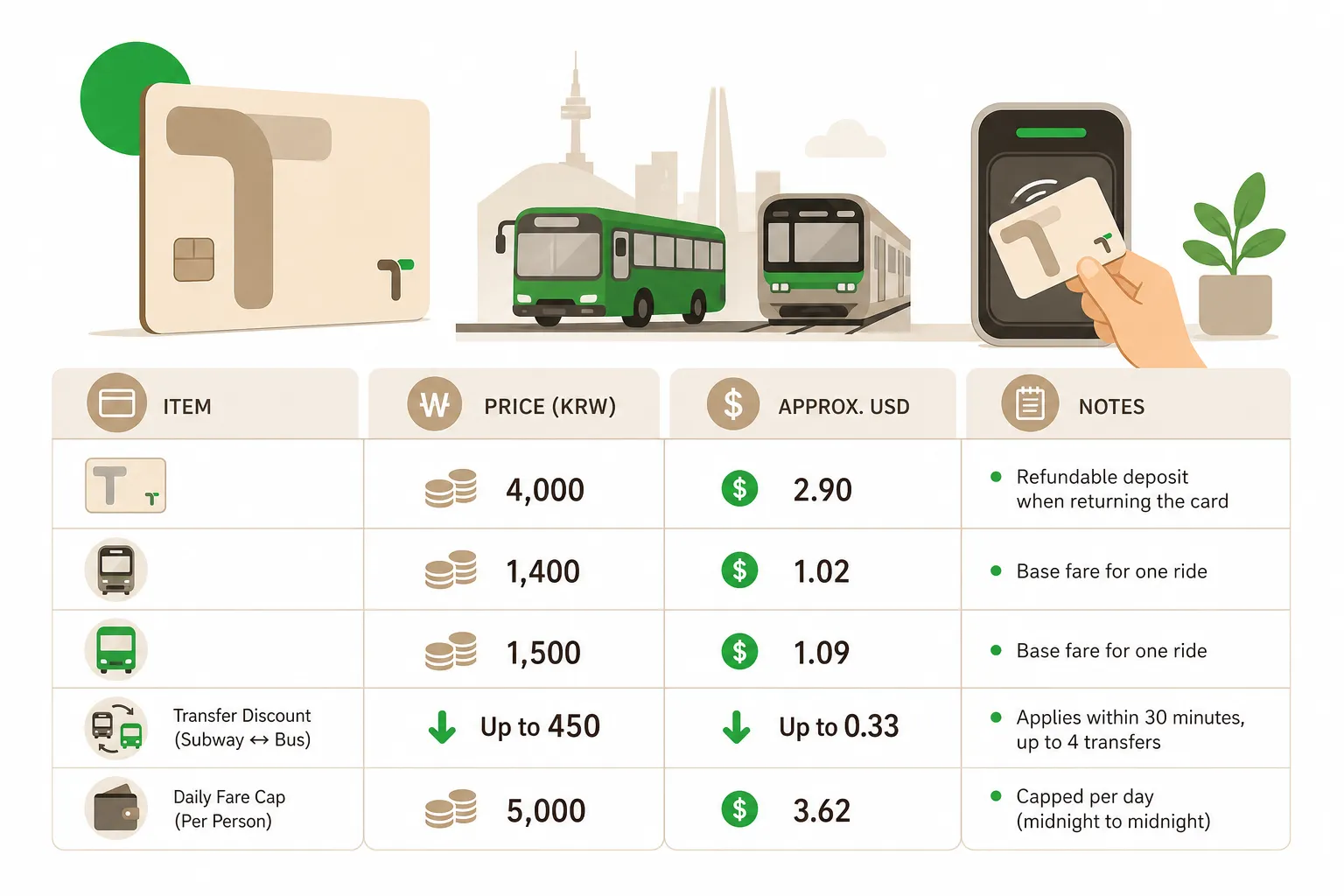
What exactly is a T-money card and where can you use it
T-money is a rechargeable stored-value card for Korea's public transport, and it goes far beyond Seoul. It's valid on subways and buses in Busan, Daegu, Jeju, and many other cities nationwide, plus many convenience stores and vending machines accept it as payment. Many taxis take T-money too, though not all drivers do, so ask 'T-money OK?' before you get in rather than assuming. Character editions from Kakao Friends, BT21, or Sanrio cost more than the plain plastic card. For a multi-city trip, one card covers the whole itinerary, simpler than juggling city-specific transit cards elsewhere.
How much does a T-money card cost and where do you buy one
A basic T-money card costs ₩2,500–₩4,000 (~$2–3) and is sold at GS25, CU, 7-Eleven, Ministop, emart24, and Story Way, as well as station vending machines. No passport, ID, or registration is required, you simply pay the card price and ask for a T-money card. Some older sources cite a ₩5,000 (~$4) initial price bundled with a small top-up, so treat ₩2,500–₩4,000 (~$3) as the current range and expect minor store-to-store variation. Load ₩20,000–₩30,000 (~$21) at a time so you are not recharging daily, and the card itself never expires, so it's fine to buy one even for a two-day visit.
How T-money fares and transfers actually work
Fares are distance-based, not flat: the Seoul subway base fare with T-money is ₩1,550 (~$1) and covers roughly the first 10 km, then about ₩100 (~$1) more per additional 5 km. A single paper ticket costs ₩100 (~$1) more than the T-money fare for the same trip. City bus base fare (blue and green routes) sits at ₩1,500 (~$1) as of August 2024. The real advantage is on transfers: tap again within 30 minutes of getting off (extended to 60 minutes between 9 PM and 7 AM) and the system charges total distance rather than a fresh base fare, for up to 4 transfers across 5 rides. Tap your card exiting the bus or subway gate too, or you lose the transfer discount and may be overcharged.
T-money vs. the Climate Card and single tickets
If you're in the Seoul area for a month riding transit daily, compare the Climate Card against pay-per-ride T-money. It's a 30-day unlimited pass at ₩65,000 (~$46) including public bike (Ttareungyi) use, or ₩62,000 (~$44) without, confirmed as of April 2025. For a short trip of a few days, plain T-money with occasional top-ups is simpler and cheaper. Single paper tickets cost more per trip and require a deposit refunded at the station, so most visitors skip them once they have T-money. Apple Pay and Samsung Pay now support T-money tap-to-ride on compatible phones.
Getting a refund when you leave Korea
You can refund a leftover balance under ₩20,000 (~$14) at convenience stores, minus a small service fee deducted before you get cash back. Higher balances may require a dedicated T-money service counter rather than a regular register, so cash down your balance before your last ride if possible. Since the card doesn't expire, many travelers just keep it for a future trip instead of refunding a small remaining balance.
The card itself is simple, but distance-based fares, the transfer tap-out rule, and which city's buses accept T-money trip up first-time visitors more than any other transit detail in Korea. Getting a transfer wrong or forgetting to tap out on a bus costs you the discount, not a large sum, but it adds friction on a day when you're already navigating an unfamiliar system.
If you want a full transport plan mapped to your itinerary instead of figuring out fares station by station, KOncierge builds one for you at
Ask KOnciergeBy passport
- United States / Canada
- No visa or K-ETA affects buying a T-money card; it's a cash purchase at any convenience store regardless of passport.
- United Kingdom / Australia
- Same as above, T-money purchase requires no ID check, only the transit fare rules apply equally to all visitors.
- Singapore / Malaysia
- If you're used to EZ-Link or Touch 'n Go, T-money works on the same tap-in/tap-out logic, but Korea's transfer window (30–60 minutes) is more generous than most Southeast Asian systems.
Frequently asked questions
How much does a T-money card cost in Korea?
A basic T-money card costs ₩2,500 to ₩4,000 (~$3) (roughly $2–3) at convenience stores like GS25, CU, and 7-Eleven, with no ID or registration required. That price is for the card only, separate from whatever balance you load onto it, and most travelers add ₩20,000–₩30,000 (~$21) on top for the first charge.
Do I need T-money if I'm only in Korea for a few days?
Yes, it's worth it even for a short trip because it saves ₩100 (~$1) per ride compared to single paper tickets and gives you free or discounted transfers between subway and bus. Since the card never expires, there's no downside to buying one on day one rather than fumbling with ticket machines for individual rides.
What's the biggest misconception about T-money transfers?
Many visitors assume transfers are simply free, but they're actually calculated by combined distance rather than charged as a flat discount. And you must tap out when leaving each vehicle to get the benefit at all. Skip the tap-out and you lose the transfer pricing and may be billed as if you took two separate full-fare trips.
Can I use a T-money card outside Seoul?
Yes, T-money is accepted on subways and buses in Busan, Daegu, Jeju, and many other Korean cities, not just Seoul's network. Coverage on taxis varies more by city and even by individual driver, so it's worth asking before boarding a cab outside the capital.
Is the Climate Card better value than regular T-money?
It depends on how much you ride: the Climate Card is a 30-day unlimited pass at ₩65,000 (~$46) with bike-share access or ₩62,000 (~$44) without. Which pays off if you're taking multiple trips daily for a month. For a trip of a few days to a week, standard pay-per-ride T-money with periodic top-ups is cheaper overall.
Can I get a refund for money left on my T-money card?
Yes, balances under ₩20,000 (~$14) can be refunded directly at convenience stores, minus a small service fee deducted from the refund. Larger balances typically need a dedicated T-money service counter, so many travelers just spend down the balance or keep the card for a future visit since it doesn't expire.
Sources
- Korea Subway & T-money Card Guide (Trazy) — blog.trazy.com
- T-money Card Korea: How to Use (KoreaLocally) — korealocally.com
- T-money Card Korea Guide (KoreaPeek) — koreapeek.com
- T-money Card Korea & Seoul Transport (InCorea) — incorea.it
- T-money Card Transportation Korea (South Korea Hallyu) — southkoreahallyu.com
- Korea T-money Card (Discover Real Korea) — discoverrealkorea.com
How was this article?


