

Seoul Subway for Foreigners: Fares, Passes, and How to Ride (Updated July 2026)
Current Seoul subway fares, T-money vs. Climate Card Tourist Pass pricing, and how to navigate without Korean — updated after the 2025 fare increase.
The Seoul subway is easy to use without Korean: stations are numbered and signed in English, and a rechargeable T-money card (or a phone with Naver Map/Google Maps for routing) gets you anywhere on the network. A single ride with a transportation card costs ₩1,550 (~$1.10) at base fare, rising with distance, and visitors typically use either T-money pay-as-you-go or the Climate Card Tourist Pass, priced from ₩5,000 (~$3.60) for one day to ₩15,000 (~$11)
| Option | Price | Duration/Coverage | Best for |
|---|---|---|---|
| Base adult fare (card) | ₩1,550 (~$1.10) | Single ride, first 10km; +₩100 (~$1) per 5km after | Occasional riders, short stays |
| Base fare, cash/single ticket | ₩1,650 (~$1.20) | Single ride, no card needed | One-off riders without T-money |
| Teenager fare | ₩900 (~$0.65) | Ages 13-18, card required | Traveling with teens |
| Child fare | ₩550 (~$0.40) | Ages 6-12, card required | Traveling with young children |
| Climate Card Tourist Pass - 1 day | ₩5,000 (~$3.60) | Unlimited subway + bus in Seoul, 1 day | Single-day sightseeing sprint |
| Climate Card Tourist Pass - 2 day | ₩8,000 (~$5.70) | Unlimited subway + bus in Seoul, 2 days | Weekend visitors |
| Climate Card Tourist Pass - 3 day | ₩10,000 (~$7.10) | Unlimited subway + bus in Seoul, 3 days | Typical short trip |
| Climate Card Tourist Pass - 5 day | ₩15,000 (~$10.70) | Unlimited subway + bus in Seoul, 5 days | Week-long stays with heavy transit use |
| Climate Card (resident, 30-day) | ~₩62,000-65,000 (~$44-46) | 30 days unlimited subway/bus, optionally + Ttareungi bikes | Long-stay visitors, digital nomads |
| T-money card purchase | ₩3,000 (~$2.10) | One-time card cost, reload as needed | Anyone riding more than once or twice |
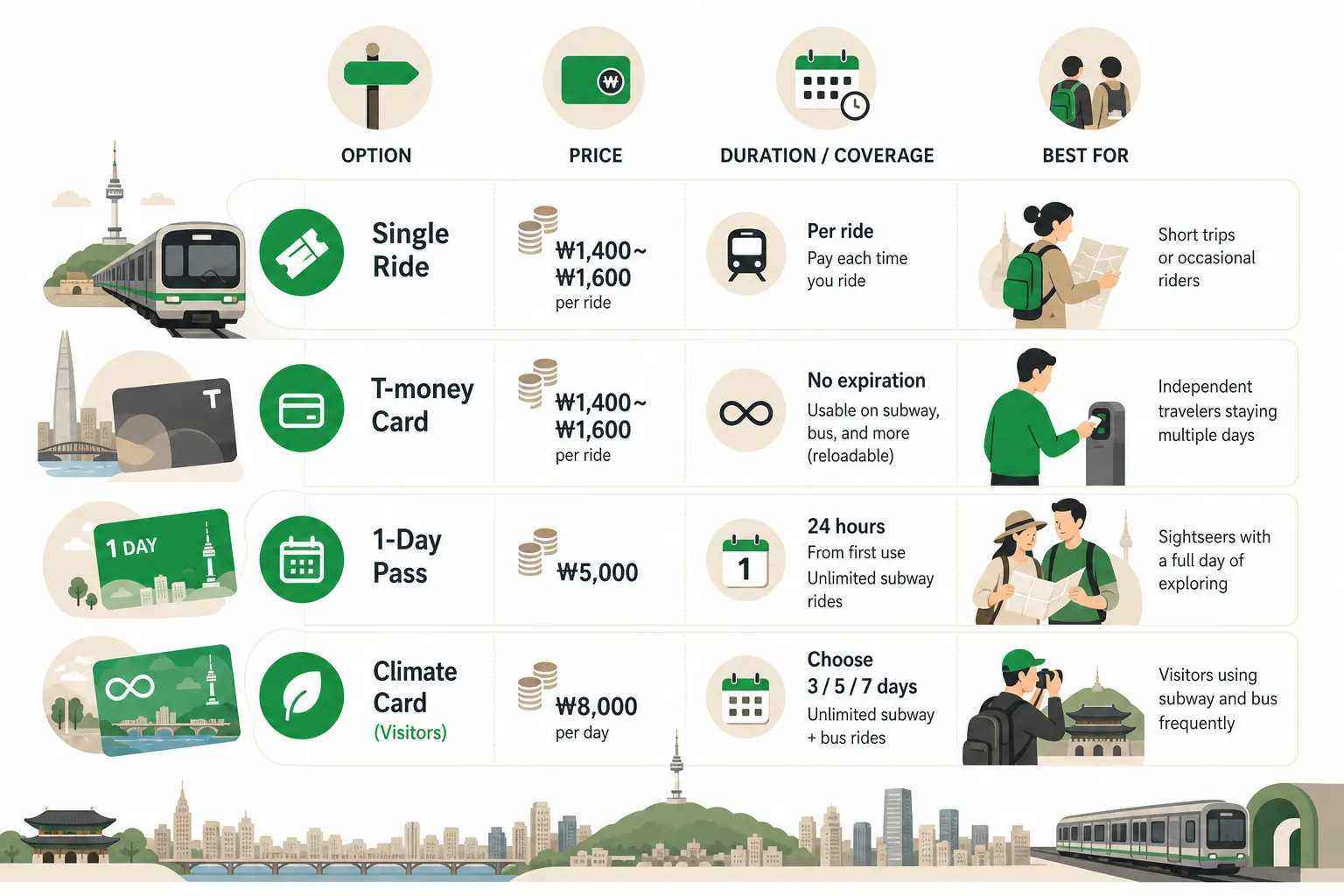
How do fares actually work on the Seoul subway?
Fares are distance-based, not flat: the base fare rose to 1,550 won for card users starting June 28, 2025, covering the first 10 kilometers, and every additional 5 kilometers after that adds about ₩100 (~$1). This follows an earlier increase from 1,250 won to 1,400 won in October 2023, so fares have climbed twice in under two years. The increase applies uniformly across Seoul, Incheon, and Gyeonggi Province, since the three run on one integrated fare system — a ride that starts in Seoul and ends in Gyeonggi is charged as one continuous trip, not two separate fares.
T-money card or Climate Card Tourist Pass: which should you buy?
It depends on how many rides you will take. A T-money card costs ₩3,000 (~$2.10) to buy at any convenience store or subway station, then you load cash onto it and pay per ride at the discounted card rate — this is the flexible default for anyone unsure of their exact itinerary. If you know you will ride the subway or bus more than roughly 4-5 times in a single day, the Climate Card Tourist Pass breaks even fast: ₩5,000 (~$4) for one day of unlimited rides, up to ₩15,000 (~$11) for five days.
Where do you buy a T-money card or Climate Card, and how do you reload it?
You can buy a T-money card at any GS25, CU, or 7-Eleven convenience store, or from ticket machines inside subway stations, for about ₩3,000 (~$2). The Climate Card can be purchased for 3,000 won at Seoul Metro information centers and nearby convenience stores; the tourist pass version is sold as a preloaded card, so there's no separate reload step for short trips. Reloading either card is done at the same subway ticket machines or convenience store counters — hand over cash and specify the amount, since most machines accept Korean won only. Tap in and out at turnstiles with the card each time; failing to tap out at a bus transfer or subway exit can trigger a higher fare on your next tap.
Do you need Korean to navigate the subway?
No — every station has an English name and a line number/color displayed on signs, platform screens, and train announcements, and most ticket machines offer an English-language interface. Naver Map and KakaoMap are more reliable than Google Maps for real-time Korean transit routing, since Google's transit data in Korea is limited; both apps show exact platform numbers, transfer walking times, and last-train schedules. Station names are announced in Korean and English on board, and exits are numbered so you can navigate by exit number rather than by street name, which matters in a city where English street signage is inconsistent.
The subway itself is simple, but pass math (T-money vs. Climate Card Tourist Pass), fare transfers across three provinces, and non-English ticket machine edge cases can cost first-time visitors time or a few dollars in wasted fares. If your itinerary involves day trips to Incheon or Gyeonggi where the tourist pass doesn't reach, KOncierge can build a transit plan around your actual stops so
Ask KOncierge to map your Seoul transit route and pass choice before you land.
Ask KOnciergeBy passport
- United States/Canada/Australia/UK
- No special transit permit needed; standard tourist entry (K-ETA or visa-free per your passport) applies before you even reach the subway.
- Singapore/Malaysia
- Visa-free short-stay entry typically applies; the subway fare and card system work identically regardless of visa status.
Frequently asked questions
How much does the Seoul subway cost for a foreigner?
The base fare is ₩1,550 (~$1.10) with a T-money card for the first 10km, rising by about ₩100 (~$1) per additional 5km. Per the June 2025 fare increase. There's no separate 'foreigner fare' — everyone pays the same distance-based rate, whether you use T-money or the Climate Card Tourist Pass, which runs ₩5,000-₩15,000 (~$11) depending on how many days of unlimited travel you buy.
What's the biggest misconception foreigners have about the Seoul subway?
That it's a flat fare like many home-country systems. Seoul's subway charges by distance, so a short hop and a cross-city trip cost different amounts, and the fare keeps accumulating if you stay on a connecting bus. The other common mix-up is assuming Google Maps gives full Seoul transit directions — it often can't, so Naver Map or KakaoMap is the more reliable choice for platform-level routing.
Should I buy T-money or the Climate Card as a tourist?
If you're taking fewer than about 4-5 rides a day, a standard T-money card (₩3,000 (~$2) plus loaded fare) works fine and is refundable at the airport. If you're sightseeing heavily — museums, palaces, and multiple neighborhoods in one day — the Climate Card Tourist Pass at ₩5,000-₩15,000 (~$11) for 1-5 days of unlimited rides usually costs less overall.
Can I use my phone to pay instead of a physical card?
Korean mobile payment integration for T-money on foreign phones (especially non-Samsung Android and most iPhones outside Korea's local Apple Pay rollout) is inconsistent. So a physical T-money or Climate Card is still the most reliable option for visitors. Locals increasingly tap with Korean-issued phones, but don't count on your home-country phone's NFC wallet working at the turnstile.
Do subway fares differ between Seoul, Incheon, and Gyeonggi?
No — the fare increase to 1,550 won applies uniformly across Seoul, Incheon, and Gyeonggi Province. Since they share one integrated fare system with automatic transfers. What differs is pass coverage: the Climate Card Tourist Pass only covers Seoul city transport, not Gyeonggi or Incheon local buses, even though the subway fare itself is shared.
Is the subway safer or faster than taking a taxi in Seoul?
The subway is generally faster during rush hour and daytime traffic, since it isn't affected by road congestion, and it's very safe at any hour with heavy foot traffic and station staff on hand. Taxis make sense late at night after the last train or when carrying heavy luggage between stations without elevators, though most Seoul stations now have elevator access.
Sources
- Seoul subway fares to increase to 1,550 won starting June 28 - The Korea Herald — koreaherald.com
- Subway base fares in Seoul, nearby areas rise by 150 won - The Korea Herald — koreaherald.com
- Seoul subway fares to rise by 150 won after presidential election in June - The Korea Times — koreatimes.co.kr
- Climate Card - Seoul Metropolitan Government — english.seoul.go.kr
- Seoul Launches 'Climate Card Tourist Pass' With 1,2,3, and 5-day Options - Seoul Metropolitan Government — english.seoul.go.kr
- Transportation Cards - VISITKOREA — english.visitkorea.or.kr
How was this article?


