
Korea Street Food Guide: What to Eat, Where, and What It Costs (Updated July 2026)
What to eat at Gwangjang Market and other Korean street food stalls, with hours, prices in KRW/USD, and the etiquette first-time visitors miss.
Korea's street food scene centers on covered traditional markets, not roadside carts alone, with Seoul's Gwangjang Market as the single best-known stop for tteokbokki, bindaetteok, mayak gimbap, and raw beef yukhoe. Expect to pay ₩4,000-10,000 (~$3-7) per dish, with a full grazing session running ₩14,000-28,000 (~$10-20) per person.
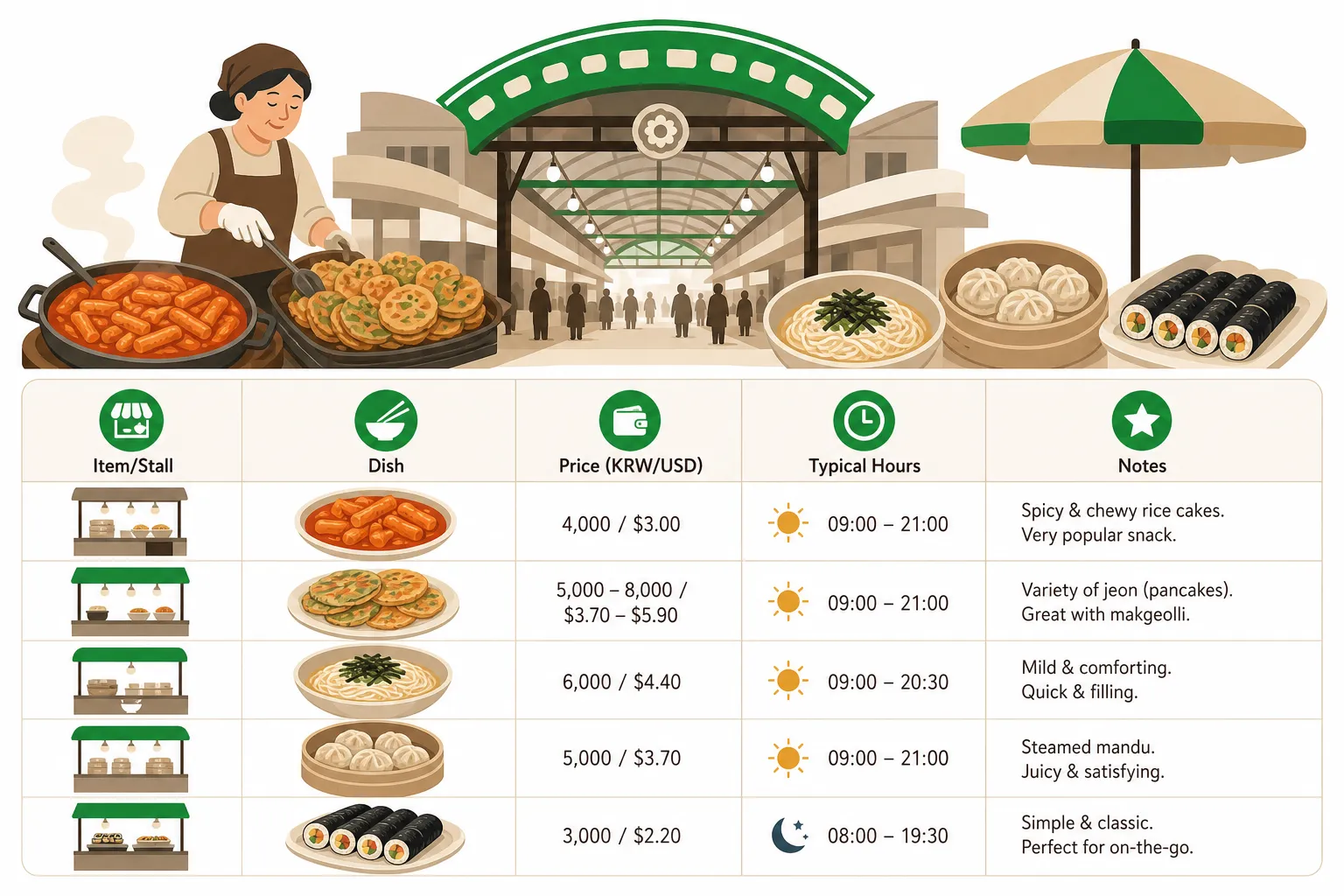
| Item/Stall | Dish | Price (KRW/USD) | Typical Hours | Notes |
|---|---|---|---|---|
| Gohyang Kalguksu (Stall A70) | Handmade knife-cut noodles | ₩6,000 (~$4.30); with dumplings ₩7,000 (~$5) | 08:00-23:00 | One of the market's oldest noodle counters, per Creatrip |
| Park Bindaetteok (Stall A59) | Mung bean pancake (bindaetteok) | ₩5,000 (~$3.60) per piece; +₩5,000 (~$4) for meat topping | 08:00-22:00 | Long-running stall named for its owner |
| General market stalls (shops/retail) | Fabric, secondhand clothing, side dishes | n/a | 10:00-19:00, closed Sundays | Non-food retail section, separate hours from food stalls |
| Snack/food vendors (market-wide) | Tteokbokki, mayak gimbap, sundae, yukhoe | ₩4,000-10,000 per plate (~$3-7) | 09:00-23:00, open year-round | Individual stalls vary; some close Sun or Mon |
| Full grazing session (per person) | 3-4 small dishes shared | ₩14,000-28,000 (~$10-20) | n/a | Klook estimates $2-5 per plate |
| Address / access | 88 Changgyeonggung-ro, Jongno-gu, Seoul | n/a | n/a | 8-min walk from Exit 8, Jongno 5-ga Station |
| Hours vary widely by source and by individual stall; always check the specific vendor when you arrive. | n/a | n/a | n/a | n/a |
What counts as Korean street food, and where do you find it
Korean street food splits into two settings: open-air carts (pojangmacha) selling one or two items like hotteok or fish cakes, and covered traditional markets where dozens of stalls sit side by side under one roof. For visitors, the market format matters more, because it lets you compare, sit down, and eat a full meal rather than a single snack. Gwangjang Market in Jongno-gu is the reference point most guides point to, established in 1905 and still built around narrow aisles of specialty stalls rather than food-hall seating. Other cities have equivalents (Busan's Jagalchi and BIFF Square, Jeonju's Nambu Market), though this guide focuses on Gwangjang, the one most first-time visitors reach easily by subway. Expect no English menus at most counters; pointing at what the stall next to you is eating works fine.
Gwangjang Market hours: why every source lists something different
Gwangjang Market's opening hours differ depending on which section and which stall you mean, which is why guides disagree and why this section carries a review flag rather than a single confirmed schedule. The Soul of Seoul lists stores at 8:30am-6:00pm and restaurants at 8:30am-11:00pm; Solosophie gives the same split. Novacircle's listing shows 09:00-22:30 daily, and Creatrip separates general retail (10:00-19:00, closed Sundays) from snack vendors (09:00-23:00, year-round).
What to order and what it costs
Gwangjang's signature dishes are tteokbokki (spicy rice cakes), bindaetteok (mung bean pancake), mayak gimbap (bite-sized "drug" gimbap, named for being addictively good), sundae (blood sausage), and yukhoe (raw seasoned beef). At Park Bindaetteok, a single pancake runs ₩5,000 (~$3.60), with a meat-topped version adding another ₩5,000 (~$4). At Gohyang Kalguksu, a bowl of hand-cut noodles is ₩6,000 (~$4.30), or ₩7,000 (~$5) with dumplings added. Across the market generally, plates run $2-5 each per Klook's estimate, with a realistic per-person budget of $10-20 if you're sampling three or four items with a friend. These stall-level prices are drawn from a 2022-dated source and likely understate current costs, so treat them as a floor rather than today's exact number.
Market etiquette and common mistakes
Most stalls expect cash; some smaller vendors are cash-only, so carry ₩20,000-30,000 (~$21) in small bills for a market visit. Seating is shared and tight — you often eat standing at a counter or on a shared bench, and lingering after you finish isn't the norm during busy hours. One source reports that a small number of stallholders have been accused of overcharging tourists; this single-source claim isn't independently confirmed, so confirm the price before you order if it isn't posted, just in case. A newer addition worth knowing is the Olive Young branch that opened inside the market in 2026, useful if you need sunscreen or a bathroom stop mid-crawl.
A street food market doesn't require booking, but stall-by-stall inconsistency in hours, cash-only counters, and no English menus mean a wasted trip if you arrive at the wrong time or can't communicate an order. KOncierge's local guides can build a market crawl around stalls that are actually open that day and handle the ordering in Korean, which saves a repeat visit.
Ask KOncierge to build a Gwangjang Market food crawl around your schedule
Ask KOnciergeFrequently asked questions
How much does street food cost in Korea?
At a market like Gwangjang, individual dishes run roughly ₩4,000-10,000 (~$3-7), with pancakes and noodle bowls at the lower end and meat-topped or combo dishes higher. A realistic budget for a full grazing session of three to four shared dishes is ₩14,000-28,000 (~$10-20) per person, though these figures come from sources that may be a few years old and likely understate current prices.
Is Gwangjang Market open every day?
Officially yes, but in practice no single answer covers every stall. The retail/general market section is typically closed Sundays, while food and snack vendors run closer to year-round, and individual stalls take their own rotating days off, often Sunday or Monday, so don't assume your target stall is open just because the market itself is.
What's the biggest misconception about Korean street food?
That it's mainly a cart-and-cash affair eaten walking down a street. The signature experience for most visitors is actually a covered traditional market like Gwangjang, where you sit or stand at a stall counter and order a real dish, not a quick snack from a mobile cart. The "street" in the name is more about informality and price than literal roadside eating.
What should I order first at Gwangjang Market?
Start with bindaetteok (mung bean pancake) and mayak gimbap, the two dishes most repeatedly named across guides to the market. Then add tteokbokki or a bowl of kalguksu noodles if you're still hungry. Yukhoe (raw beef) is worth trying if you're comfortable with raw meat, but it's a bigger commitment for a first-timer than the fried or noodle options.
Do I need cash for Korean street food markets?
Bring cash, ideally ₩20,000-30,000 (~$21) in smaller bills, since many individual stalls are cash-preferred or cash-only even though larger shops nearby take cards. This is one area where the market experience differs from convenience stores and restaurants elsewhere in Seoul, which are almost universally card-friendly.
How do I get to Gwangjang Market?
The market sits at 88 Changgyeonggung-ro in Jongno-gu, Seoul, about an eight-minute walk from Exit 8 of Jongno 5-ga Station. It's an easy add-on to a day that also includes Dongdaemun or Insadong, both a short subway ride or walk away.
Sources
- Gwangjang Market Visit - Seoul/Korea (Creatrip) — creatrip.com
- Gwangjang Market: How To Get There & What To Eat – The Soul of Seoul — thesoulofseoul.net
- How to Visit Gwangjang Market 광장시장 (and what to eat) — solosophie.com
- Gwangjang Market: Everything You Need Before Visiting (Klook) — klook.com
- Gwangjang Market, Seoul - 36 Foods & Drink To Try (South Korea Hallyu, 2026) — southkoreahallyu.com
- Opening Hours Gwangjang Market - Seoul, South Korea (Novacircle) — novacircle.com
How was this article?